Offline synchronization and mobile source-of-truth design
Design mobile features around unreliable transport, durable intent, retries, conflicts, and user-visible truth.
Mobile system design begins with constraints that a server cannot control: networks change quality or disappear, process lifetime is uncertain, storage is finite, radio use has a cost, and a user may leave during any operation. An offline-capable design must therefore distinguish what a user has asked the device to do from what the server has durably acknowledged.
This chapter establishes a vocabulary for that distinction. It treats local intent, queued work, attempted transport, server acknowledgement, conflict resolution, and visible state as separate concepts. A design is credible only when it names the behavior at each of those boundaries.
Learning goals
- Separate local intent from remote acknowledgement.
- Design idempotent writes, outboxes, and an explicit conflict policy.
- Choose among fetch, push, periodic, and push-triggered synchronization deliberately.
- Define product truth that the interface can render consistently.
- Structure a time-bounded Android system-design answer around the riskiest data path.
Separate local intent from remote acknowledgement
For an offline-capable write:
- Persist the user’s change and an outbox operation in one local transaction.
- UI reads local state immediately (optimistic or pending).
- A worker drains the outbox under network constraints.
- Server responses update local rows and clear/fail operations.
suspend fun updateNote(note: Note) = db.withTransaction {
    noteDao.upsert(note.copy(syncState = SyncState.PENDING))
    outboxDao.insert(
        OutboxOp(
            operationId = Uuid.random().toString(),
            type = OpType.UPDATE_NOTE,
            entityId = note.id,
            payload = note.toPayload(),
            createdAt = clock.now(),
        )
    )
}
Why the operation ID matters
Networks fail after the server applied a write but before the client saw the response. A client retry without idempotency creates duplicates. An operation ID (or idempotency key) lets the server recognize a retry and return the previous result.
POST /notes/123
Idempotency-Key: 6b1e0c2a-...
Define product truth
Before drawing boxes, write sentences like:
- “The note list shows last known local state, with pending badges on unsynced edits.”
- “If two devices edit the same note, last-writer-wins by server timestamp” (or CRDT, or manual merge - pick one).
- “Deletes are tombstones until sync completes.”
- “Auth expiry pauses the outbox and routes the user to re-login without losing queued ops.”
If product truth is vague, engineers invent three competing truths in UI, cache, and server.
Sync patterns
| Pattern | Mechanism | Good for |
|---|---|---|
| Read-through cache | Show DB; refresh from network | Feeds, catalogs |
| Outbox writes | Queue mutations | Notes, drafts, likes |
| Delta sync | updatedSince / version tokens | Large collections |
| Full snapshot | Replace partition | Small rare datasets |
| Push-triggered | FCM → fetch | Chat, breaking updates |
| Periodic | WorkManager | Non-urgent reconciliation |
Pagination and sync
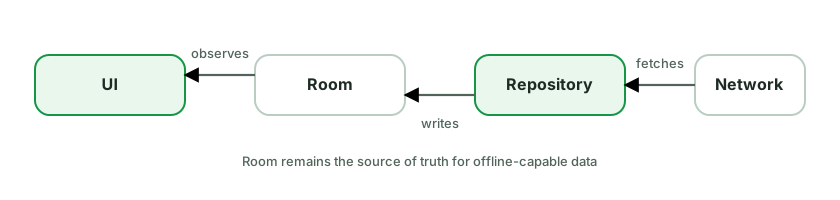
Cursor/page tokens are server read concerns; local DB remains the UI source of truth. Avoid “in-memory only” pages if offline matters.
// Remote page → upsert into Room → PagingSource reads Room
suspend fun loadNext(pageToken: String?) {
    val response = api.list(pageToken)
    dao.upsertAll(response.items.map { it.toEntity() })
    remoteKeysDao.save(response.nextToken)
}
Conflicts
Conflict policy is a product decision with technical teeth:
| Strategy | Meaning | UX impact |
|---|---|---|
| Last-writer-wins | Highest timestamp/version wins | Simple; silent data loss possible |
| Server authoritative | Client always rebases | Need clear “your edit was overwritten” |
| Field merge | Merge non-overlapping fields | Complex |
| CRDT / OT | Convergent structures | Heavy; great for collaborative text |
| Manual resolve | User picks | Honest; more UI |
Interviewers listen for you naming the conflict class for the domain (banking ≠ notes ≠ collaborative docs).
Retries, backoff, and ordering
- Retry transient failures (timeouts, 502) with exponential backoff + jitter.
- Do not blindly retry non-idempotent POSTs without keys.
- Preserve per-entity ordering if operation order matters (create before update).
- Use WorkManager constraints:
NetworkType.CONNECTED, battery, etc.
val request = OneTimeWorkRequestBuilder<OutboxWorker>()
    .setConstraints(
        Constraints.Builder()
            .setRequiredNetworkType(NetworkType.CONNECTED)
            .build()
    )
    .setBackoffCriteria(BackoffPolicy.EXPONENTIAL, 30, TimeUnit.SECONDS)
    .build()
Security and trust on device
Offline-first does not mean “trust the client forever.”
- Authenticate every sync call; refresh tokens carefully (single-flight refresh).
- Store secrets in Keystore-backed storage; not plain SharedPreferences.
- Validate server data before upsert (ignore impossible states).
- Consider encrypted DB if threat model requires it (performance cost).
Resource constraints unique to mobile
Call these out unprompted in designs:
- Battery & radios - batch transfers; avoid wakeups.
- Storage - bound caches; eviction policy; user-visible media sizes.
- Process death - outbox on disk, not memory.
- Bandwidth - delta sync, compression, image sizes.
- OS background limits - WorkManager vs forbidden background services.
A skeleton system-design answer (notes app)
- Requirements - offline edit, multi-device, eventual consistency, conflict policy LWW, auth.
- Client architecture - single Activity, feature module, Room source of truth, outbox, WorkManager, repository.
- API - CRUD + idempotency keys +
updatedSincefeed; 401 handling. - Data model -
notes,outbox,sync_metadata; tombstones. - Sync algorithm - push outbox; pull deltas; apply transactions; surface errors.
- Edge cases - clock skew, partial failure, large attachments (upload session), logout with pending ops.
- Observability - sync success rate, outbox age, conflict counts.
- Trade-offs - LWW simplicity vs possible silent overwrite; why not full CRDT yet.
Caching layers
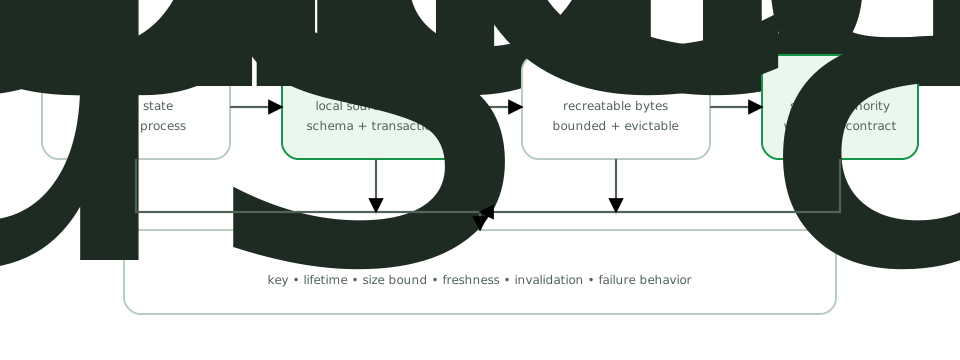
Each layer needs size limits and invalidation rules. “Cache everything forever” is not a strategy.
Common pitfalls
- Optimistic UI without durable outbox - data vanishes on process death.
- Duplicate creates from naive retries.
- Using only in-memory state for multi-screen flows that must survive.
- Ignoring auth expiry mid-sync.
- Designing server-only truth while product promised airplane-mode editing.
Examination prompts
- “Design offline notes / queue / chat / photo backup.”
- “What if the response is lost after success?”
- “How do two devices conflict?”
- “What runs when the app is backgrounded?”
- “How do you show sync status without lying?”
- “Where is the source of truth?”
Practice checklist
- Write an outbox schema and drain algorithm for a single entity type.
- List ten failure modes for “edit note offline, open on second phone.”
- Practice a 5-minute whiteboard of delta sync + pagination.
- Define metrics you would alert on for sync health.
What you should be able to explain
- Local intent vs remote ack with idempotency.
- Outbox + worker pattern.
- Conflict policy as product + engineering.
- Mobile constraints in system design.
- Structured interview delivery.
Next: Reliability, observability, and technical decisions - shipping and living with the system you designed.
Discussion
Comments are powered by GitHub Discussions. Sign in with GitHub to join in.